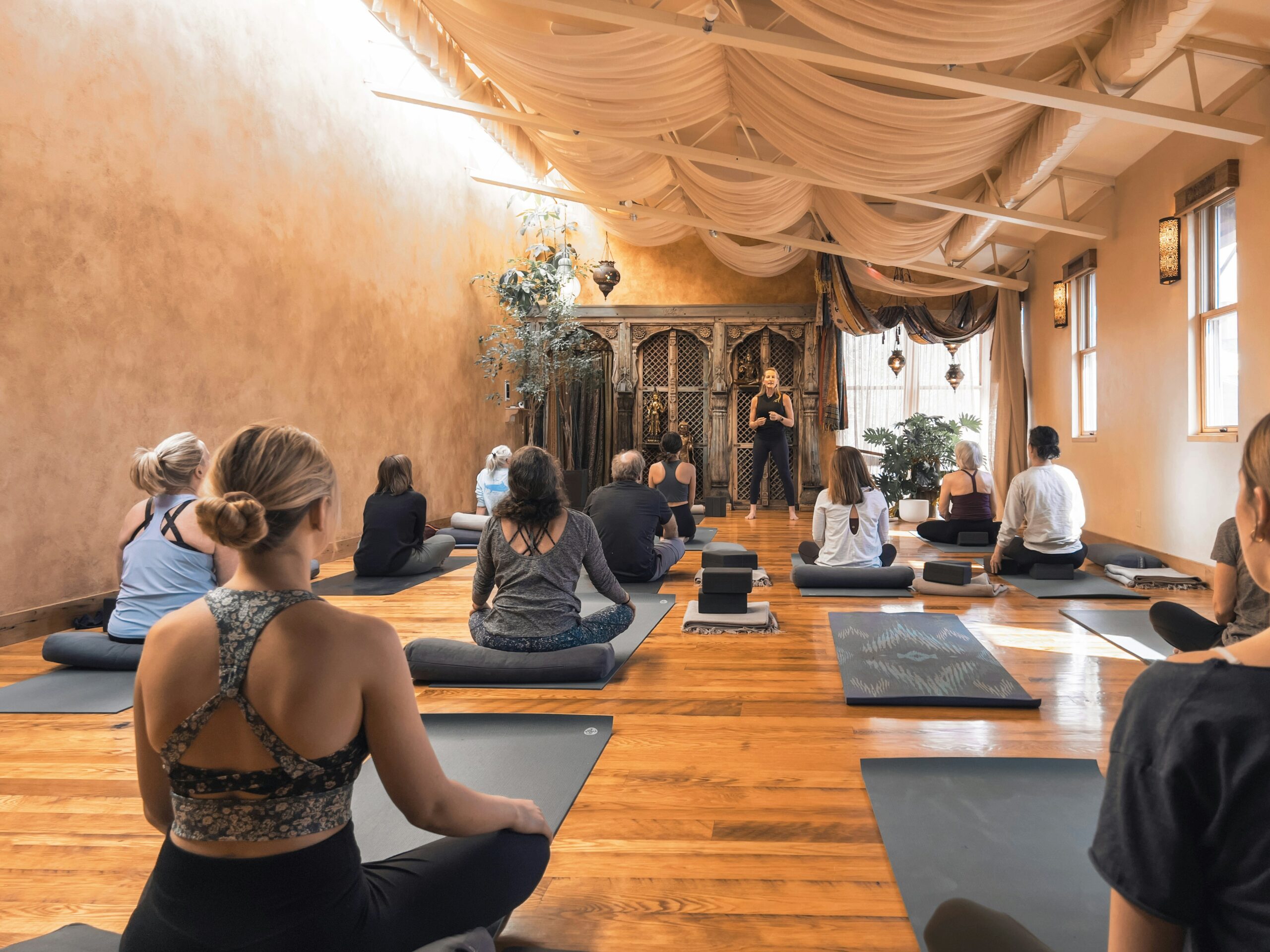

At some point, the idea of trying yoga begins to sound appealing. Perhaps a friend has been telling you about their weekly classes, you have noticed a yoga studio in your neighbourhood, or you have seen people practising beside the sea on a quiet morning. The images usually suggest a peaceful atmosphere, gentle movements and an almost effortless sense of balance. What they rarely show is what the experience actually feels like when you are stepping onto a yoga mat for the first time.
You might wonder whether you will be able to follow the instructor, whether everyone else will already know what they are doing, or whether you need to be particularly flexible to participate. Then there are the different styles to consider. Hatha, Vinyasa, Yin and Restorative Yoga may all appear on a studio schedule, but their names do not necessarily explain what happens during a class or which one would suit you best.
The good news is that you do not need to understand every yoga tradition or master a collection of poses before getting started. A suitable beginner class is designed to introduce the practice gradually, allowing you to become familiar with the movements, breathing techniques and instructions at a manageable pace.
Yoga can take many forms. Some classes involve slow, deliberate movements and time spent exploring individual postures. Others follow a more continuous sequence that can feel physically demanding. There are also practices that place greater emphasis on stillness, breathing or supported relaxation. Understanding these differences can help you approach your first class with realistic expectations and choose an experience you are more likely to enjoy.
What is yoga really, and what happens in a class?
Yoga has its roots in traditions developed in India and encompasses a broad range of philosophical teachings and practical disciplines. In the modern classes commonly offered by studios and activity organisers, yoga often combines physical postures, breathing techniques and focused attention. Depending on the tradition and instructor, a session may also include meditation or guided relaxation.
The physical postures, known as asanas, are among the most recognisable elements of contemporary yoga. They involve different positions and movements that may challenge balance, strength, mobility and coordination. Some are performed standing, others sitting or lying down, while certain sequences involve moving between positions in a controlled manner.
A typical class might begin with a few minutes of quiet breathing or gentle movement. The instructor may then guide participants through a series of postures, explaining where to place their hands and feet, how to distribute their weight and how to adjust a movement when necessary. Depending on the style, the class may progress through a flowing sequence or spend more time exploring individual positions.
Breathing is another important part of many yoga practices. Instructors often encourage participants to notice their breathing and, in some styles, coordinate inhalations and exhalations with movement. This can feel unfamiliar at first. When you are concentrating on where your feet should go or trying to maintain your balance, remembering to breathe comfortably may require more attention than you expected.
Over time, the connection between movement and breathing may become easier to understand. However, there is no need to force your breathing into an uncomfortable rhythm or assume that every exercise must produce a particular sensation.
Depending on the style and intensity, yoga can provide opportunities to work on mobility, muscular endurance, balance and body awareness. Some people also appreciate the opportunity to spend time concentrating on one activity without the usual distractions of their day. Experiences vary, though, and yoga should not be presented as a guaranteed solution to stress, pain or medical conditions.
Your first class might leave you feeling relaxed, physically challenged or simply curious about what you have learned. All of these are reasonable responses. The purpose of attending is to discover the practice rather than achieve a particular emotional or physical result immediately.
Hatha, Vinyasa and other yoga styles: which one should you choose?
One of the first things you will notice when looking for yoga classes is the variety of names used to describe them. Hatha, Vinyasa, Yin, Restorative and Ashtanga are among the most familiar, but the structure of a class can differ between studios and instructors.
Hatha Yoga is often associated with a steadier pace, particularly in modern beginner programmes. Classes may spend more time on individual postures, giving participants an opportunity to understand alignment, breathing and basic movement patterns. This can make certain Hatha classes a useful introduction for someone who wants to learn without feeling rushed.
However, Hatha does not automatically mean easy. Some sessions involve demanding positions or require considerable strength and concentration. The most useful information is whether a particular class is intended for beginners and how the instructor approaches modifications.
Vinyasa Yoga generally connects postures through a more continuous sequence of movement. Breathing often helps establish the rhythm, with participants transitioning between standing positions, floor-based movements and balance exercises. Depending on the class, the experience may feel energetic and physically challenging.
If you enjoy movement and prefer a session with a sense of progression, Vinyasa may appeal to you. A beginner-friendly class can introduce the sequences gradually, while more advanced sessions may move too quickly for someone unfamiliar with the basic positions.
Yin Yoga follows a different approach. It typically involves holding mainly floor-based postures for longer periods, with an emphasis on a slower pace and relatively passive positioning. Restorative Yoga also tends to move slowly, often using blankets, cushions, bolsters and blocks to support the body in restful positions.
Although these practices may appear gentler, they still require appropriate guidance. Holding a position for several minutes is not suitable for everyone, particularly when a participant has specific physical limitations or experiences discomfort.
Ashtanga Yoga is another established approach, traditionally involving structured sequences of postures. It can be physically demanding, especially for someone who has not previously practised yoga.
Rather than choosing a style based solely on its name, read the class description and consider what you want from the experience. Would you prefer to learn individual movements carefully? Are you looking for a more active session? Would you enjoy a slower class with greater emphasis on supported positions?
You can also try different styles before deciding which one feels right. Your first class is an introduction, not a commitment to a particular type of yoga.
What is your first yoga class actually like?
Your first experience begins before the class itself. Arriving a little early gives you time to become familiar with the studio, ask practical questions and let the instructor know that you are new to yoga.
If you have an injury, a health condition or a limitation that may affect your participation, it is important to mention it beforehand. Depending on your circumstances, seeking advice from a healthcare professional before beginning a new physical activity may also be appropriate.
Most classes require very little personal equipment. You will usually need comfortable clothing that allows you to move freely, and many studios provide yoga mats or offer them for hire. It is worth checking in advance rather than assuming equipment will be available. Yoga is commonly practised barefoot, although individual studios may have their own policies.
You do not need expensive leggings, specialist clothing or a collection of accessories to get started. A water bottle and suitable clothing are generally enough for an introductory session.
Once the class begins, the instructor may invite everyone to sit or lie comfortably on their mats. There might be a few minutes dedicated to breathing, followed by gentle movements involving the shoulders, spine or hips.
As the session progresses, you may encounter poses with unfamiliar names, such as Downward-Facing Dog, Warrior or Child’s Pose. Some instructors use English names, others use traditional Sanskrit terminology, and many use both. You are not expected to memorise everything immediately.
A well-structured beginner class should provide clear explanations and demonstrate suitable alternatives where necessary. You might be encouraged to bend your knees, use a yoga block or adjust the position of your hands to make a movement more accessible.
There may also be moments when you lose your balance, become confused about which direction to turn or need to look around to understand the next movement. These experiences are common when learning something unfamiliar.
It is worth remembering that yoga is not a performance. You do not need to reproduce every posture exactly as demonstrated, particularly when your body has different proportions, mobility or physical limitations.
Many classes finish with a period of rest, often in a position called Savasana, where participants lie on their backs and remain still for several minutes. Some people find this part especially enjoyable, while others initially struggle with the idea of doing nothing.
There is no particular feeling you are supposed to achieve. Your first yoga class is primarily an opportunity to become familiar with a new way of moving, breathing and paying attention.
Do you need to be flexible to start yoga?
One of the most common reasons people hesitate to try yoga is the belief that they are not flexible enough.
Social media has contributed to this impression. Photographs of deep backbends, dramatic balancing positions and complex stretches can make yoga appear to be an activity reserved for people with exceptional mobility.
Those images, however, often feature experienced practitioners who have spent years developing specific skills. They do not represent what an introductory class should expect from someone attending for the first time.
You do not need to touch your toes, perform a deep forward fold or hold an advanced balancing pose to begin yoga. Mobility varies considerably between individuals and is influenced by anatomy, previous activity, physical condition and other factors.
Many postures can be adapted by reducing the range of movement, changing the position of the body or using equipment for support. An experienced instructor should be able to explain suitable options and help participants recognise when a particular movement is not appropriate for them.
It is equally important to understand that yoga does not require you to push constantly towards greater flexibility. A gentle stretching sensation may be part of certain movements, but pain should not be treated as evidence of progress.
If a position causes pain, numbness, dizziness or unusual discomfort, stop and let the instructor know. Trying to force your body into a posture because someone else can perform it is neither necessary nor sensible.
Flexibility is also only one element of many yoga practices. Strength, balance, coordination and concentration can be equally relevant. Someone with excellent mobility may struggle with stability, while a physically strong person may find certain positions unfamiliar or challenging.
There is no universal starting point. Your experience will depend on your body, the class you choose and the way the practice is taught.
For beginners, the most useful approach is to remain curious about what you can do comfortably rather than concentrate on how your movements compare with those of other participants.
Yoga in a studio or outdoors?
Where you practise yoga can influence the atmosphere and practical experience of a class.
A studio offers a structured environment, usually with a suitable floor, controlled indoor conditions and access to equipment. The instructor can plan the session without needing to account for wind, uneven ground or sudden changes in weather.
For someone attending their first class, that predictability can be reassuring. You know where to place your mat, the instructor can move around the room and the setting is generally designed specifically for the activity.
Outdoor yoga offers something different. A class beside the sea, in a garden or in another suitable open space combines the practice with time spent in the natural environment.
The sound of waves, natural light and fresh air can create an atmosphere quite unlike that of an indoor studio. For people who spend much of their working week inside, an outdoor session may be particularly appealing simply because it provides an opportunity to be outside.
Greece offers a variety of settings for these experiences, from coastal areas to gardens and other appropriate outdoor spaces. The appeal is easy to understand, particularly during periods when the weather is comfortable.
However, outdoor yoga also requires additional planning. The surface needs to be suitable for the movements, the weather conditions must be appropriate and the organiser should consider factors such as heat, wind, sun exposure and available facilities.
Practising on an uneven surface or under intense midday sun may make certain movements uncomfortable or unsuitable. A responsible organiser should be prepared to modify, relocate or postpone a session when conditions are not appropriate.
Neither environment is inherently better. A studio may be more convenient for regular weekly classes, while outdoor yoga can offer an enjoyable change of setting.
You may discover that you appreciate both. Attending a familiar studio during the week and occasionally joining an outdoor session can provide different experiences without requiring you to choose one permanently.
The most important consideration is whether the class is appropriate for your level and organised in a way that supports safe, comfortable participation.
How to find the right yoga class for you
Choosing a yoga class involves more than finding an attractive studio or seeing a beautiful photograph of an outdoor session.
The teaching approach, experience of the instructor, level of the programme and size of the group can all influence how comfortable you feel, particularly when you are new to the activity.
Look for classes that clearly identify themselves as suitable for beginners. Read the description carefully and check whether the instructor provides explanations, offers modifications and welcomes participants without previous experience.
If the information is unclear, contact the organiser before attending. Ask what style of yoga is taught, whether the session is physically demanding and what equipment you need to bring.
It is also reasonable to ask about the instructor’s training and experience, particularly if you have specific movement limitations or concerns. An instructor should be able to explain the scope of the class and recognise when a participant may need individual advice beyond what a general group session can provide.
Location and scheduling matter more than people sometimes expect. A studio close to your home or workplace may be easier to attend consistently than one that requires a long journey. An outdoor weekend session, on the other hand, might be more attractive if you prefer occasional experiences rather than a fixed weekly commitment.
Price, class duration, cancellation policies and group size are also worth considering. A trial class can be particularly useful because it allows you to experience the instructor’s approach before committing to a longer programme.
Once you begin, give yourself time to become familiar with the movements. During the first few sessions, you may spend much of your attention trying to understand the instructions. Gradually, some positions may begin to feel more familiar, allowing you to concentrate on other aspects of the practice.
You might also discover that the style you initially chose is not the one you enjoy most. Perhaps you prefer a slower Hatha class to a more dynamic Vinyasa session, or maybe an outdoor experience appeals to you more than a traditional studio environment.
There is nothing wrong with exploring different options. Finding an activity that suits your preferences is often a process of trying things rather than making the perfect decision before you begin.
Through InAction, you can explore available Wellness and Fitness activities, discover classes and experiences offered by professionals and organisers, and find information about locations, schedules and participation requirements.
Whether you are interested in your first studio-based yoga class or would like to experience an organised outdoor session, being able to explore different activities and understand what each one involves can make the decision easier.
Your first yoga class might turn out to be something you look forward to every week. You may discover a style that challenges you in an enjoyable way, meet people with similar interests or simply appreciate having a dedicated hour for physical activity.
You might also decide after a few sessions that another activity suits you better. That is a perfectly reasonable outcome. Trying something new does not need to become a lifelong commitment to be worthwhile.
You do not have to arrive knowing the terminology, understanding every breathing technique or being able to perform the postures you have seen online. Choose an appropriate beginner class, communicate your needs to the instructor and allow yourself the opportunity to learn.
Sometimes the best way to find out whether an activity belongs in your life is to stop wondering what it might be like and experience it for yourself.
Less Scroll. More Life.