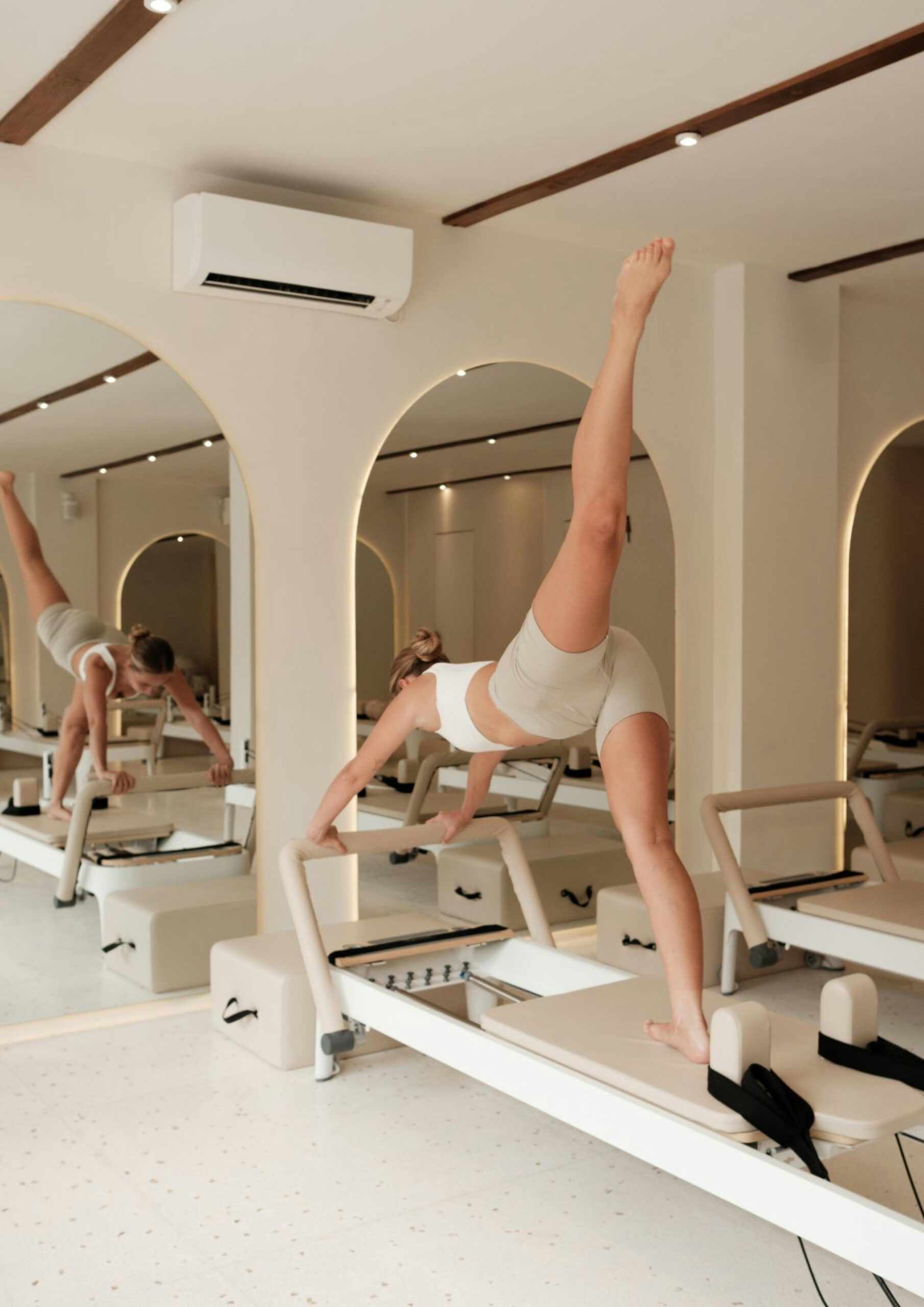

You have probably walked past a Pilates studio at some point and wondered whether you should give it a try. Maybe a friend has recently started taking classes and keeps telling you how much they enjoy them. Perhaps you have come across videos on Instagram showing people moving slowly and effortlessly through exercises that look surprisingly graceful. Then there are the reformer machines, with their springs, straps and sliding platforms, which can seem a little intimidating if you have never stepped inside a Pilates studio before. Somewhere between curiosity and uncertainty, a few questions begin to come up. Do you need to be flexible? Will you be able to keep up with everyone else? What is the difference between Mat and Reformer Pilates? And how do you know which class is right for you when you have absolutely no experience?
Your first Pilates class might turn out to be quite different from what you imagine. Movements that appear simple on a screen often require more concentration than expected, while exercises that look complicated can sometimes be adapted to suit someone who is just starting out. The way you breathe, the position of your pelvis, the movement of your spine and the coordination of different muscle groups become more important than how many repetitions you manage to complete. You might leave your first session surprised by how much attention even a small movement can require, or by how unfamiliar certain muscles feel when you begin using them in a different way.
If you are thinking about trying Pilates, understanding what actually happens during a class can make the experience feel much more approachable. Knowing what to wear, what the instructor might ask you to do and how different types of Pilates compare will help you choose a class that suits your abilities and expectations. You do not need to have everything figured out before you arrive. A little preparation and the right environment can make your first experience considerably more comfortable.
What is Pilates and why do so many people choose it?
Pilates is a method of exercise developed by Joseph Pilates in the early twentieth century. It combines controlled movement, breathing and concentration, with exercises designed to develop muscular strength, particularly around the trunk, improve movement control and support mobility. While many fitness programmes focus on speed, intensity or completing a certain number of repetitions, Pilates generally places greater emphasis on how a movement is performed. The position of the body, the coordination of different muscles and the ability to maintain control throughout an exercise are central to the method.
You begin to understand this during some of the simplest exercises. An instructor might ask you to lie on your back, bend your knees and slowly lift one leg while keeping your pelvis steady. At first, the movement may seem almost too easy to qualify as exercise. Once you try to perform it with precision, however, you may notice how much effort goes into keeping the rest of your body stable. Your instructor might suggest making the movement smaller, adjusting your breathing or changing the position of your feet. These small adjustments can make a noticeable difference to how the exercise feels and which muscles you are using.
One reason Pilates appeals to such a wide range of people is that classes can be adapted to different levels of experience and physical ability. Some people choose it as their main form of exercise, while others combine it with strength training, running, cycling or other sports. There are also people who simply enjoy having a structured activity that encourages them to slow down and pay closer attention to their movements. The experience can vary significantly depending on the instructor, the class format and the participants. An introductory session may focus on learning fundamental movements, while an advanced class can demand considerable strength, endurance and coordination.
That variety is worth remembering when you first start looking for classes. Two sessions described as Pilates may feel completely different, even if they follow the same underlying principles. Rather than choosing based only on photographs or the popularity of a studio, it helps to understand what kind of programme is being offered and whether it is designed for someone at your level.
Mat Pilates or Reformer Pilates?
One of the first choices you will encounter is whether to try Mat Pilates or Reformer Pilates. Both follow the principles of the Pilates method, but the experience of taking part can be quite different. Mat Pilates takes place primarily on an exercise mat, using your own body weight as a major source of resistance. Depending on the class, instructors may introduce small pieces of equipment such as resistance bands, exercise balls or Pilates rings. Exercises can be performed lying down, sitting, kneeling or standing, with movements designed to develop strength, stability and coordination.
Reformer Pilates uses a specially designed machine with a moving carriage, springs, straps and various support points. The springs provide adjustable resistance, although they can also assist certain movements rather than simply making them harder. This allows the instructor to modify exercises according to the participant’s abilities and the purpose of the session. Moving on a reformer feels different from exercising on a mat because you need to coordinate your body with the movement of the carriage while maintaining control of the equipment.
It is easy to assume that Mat Pilates is the beginner option and Reformer Pilates is intended for more experienced participants. In practice, the difficulty depends on the exercises and how the class is structured. Some mat exercises require significant strength and body control, while a well-designed introductory reformer class can be suitable for someone who has never tried Pilates before. Neither format is automatically easier, and both can become demanding as you progress.
If you are unsure which one to choose, an introductory class can help you make a more informed decision. You might discover that you enjoy the simplicity of working on a mat, or you may prefer the way the reformer provides resistance and support throughout different movements. The teaching style matters just as much as the equipment. Feeling comfortable asking questions, receiving clear instructions and having exercises adapted when necessary can make a considerable difference to your first experience.
What happens during your first Pilates class?
Arriving a little early for your first class is a good idea. It gives you time to find your way around the studio, understand how the session will work and introduce yourself to the instructor. Before beginning, you should have an opportunity to mention your previous exercise experience, any injuries or movement limitations and anything else that might affect your participation. If you have a medical condition or are recovering from an injury, you may need advice from an appropriate healthcare professional before taking part.
A beginner-friendly class will often start with fundamental movements that help you become familiar with body positioning and breathing. You might be asked to notice how your back rests against the mat, how your pelvis moves or how your rib cage changes position as you breathe. These instructions can feel unusually detailed if you are used to exercise classes where the main objective is to keep moving. In Pilates, however, understanding these smaller elements can help you perform more complex exercises with greater control later on.
As the session progresses, the instructor will introduce different movements involving the legs, arms and trunk. You may change positions several times, repeat exercises to become more familiar with them or receive individual corrections. Some movements will feel natural, while others may require a little patience. Coordinating your breathing with an unfamiliar exercise can be surprisingly difficult at first, especially when you are also trying to remember where to place your hands and feet. This is a normal part of learning a new physical activity, and a good instructor should be able to explain movements in different ways or offer appropriate alternatives.
Another thing that often surprises beginners is how challenging slow exercise can feel. You might spend several minutes working through a sequence of controlled movements without ever feeling as though you are exercising particularly quickly. Yet maintaining stability and precision can require sustained muscular effort. The sensation is different from running on a treadmill or lifting weights, but that does not necessarily make the class less demanding.
For your first session, choose comfortable clothing that allows you to move freely and does not restrict you when lying down or changing positions. Many studios require grip socks, particularly for reformer classes, although policies vary, so it is worth checking beforehand. A bottle of water and a small towel may also be useful. You do not need expensive workout clothes or specialist equipment simply to get started. What matters most is arriving prepared, choosing a suitable class and allowing yourself some time to become familiar with the experience.
Do you need to be fit or flexible to start Pilates?
One of the most common misconceptions about Pilates is that you need to be flexible or already in good physical condition before attending your first class. Social media can reinforce this impression, particularly when videos feature experienced practitioners performing advanced movements with remarkable precision. Watching someone move effortlessly through a difficult exercise can make it easy to forget that they may have spent years developing the strength, mobility and coordination required to perform it.
A properly structured beginner class should recognise that participants arrive with different abilities and backgrounds. You do not need to be able to touch your toes, hold an advanced position or perform every movement with perfect control. Strength, mobility and coordination can develop gradually through practice, provided the exercises are appropriate for your abilities. Some movements may feel comfortable from the beginning, while others reveal areas where you have less control or range of motion than you expected. That information can be useful, but it should not become a reason to force your body into positions it is not ready to manage.
If you regularly lift weights or participate in high-intensity training, Pilates may introduce a different kind of challenge. You might be physically strong but find that certain controlled movements require more concentration than expected. If you have not exercised consistently for some time, a suitable introductory class may offer a way to become familiar with structured movement again. In either case, the instructor should help you understand how to perform exercises at an appropriate level rather than expecting everyone to follow exactly the same version.
It is also important to distinguish between the effort associated with exercise and pain that may indicate something is wrong. Feeling your muscles working is one thing; experiencing sharp or unusual pain is another. If a movement causes pain, stop and let your instructor know so that the exercise can be assessed, modified or omitted as appropriate. Pilates is often discussed in connection with posture, mobility and physical wellbeing, but it should not be presented as a guaranteed treatment for injuries or medical conditions.
Perhaps the most useful thing you can do during your first class is stop comparing yourself with the people around you. The person on the next mat might have been practising for years, or they may simply have a different range of movement. Your first session is an opportunity to understand how Pilates works and decide whether you enjoy it. There is no need to turn it into a test of your fitness or flexibility.
How do you choose the right Pilates class?
Finding a Pilates class involves more than choosing the studio with the most attractive interior or the strongest social media presence. The instructor, the class level and the way the sessions are organised can have a significant influence on your experience. This becomes particularly important when you are new to the activity and still learning the basic movements. An appropriately trained instructor who takes time to explain exercises, observes how participants perform them and offers suitable modifications can make the learning process more comfortable and effective.
It is worth finding out whether the class is genuinely designed for beginners, how many people usually attend and whether the instructor can adapt exercises to individual needs. Smaller groups may allow more opportunities for individual feedback, although a larger class is not necessarily unsuitable if it is organised and taught well. If you have specific concerns or would prefer more personal attention, an introductory private session might be an option worth considering before joining a regular group.
Practical details matter too, often more than we expect. A beautiful studio on the other side of the city may seem appealing when you first discover it, but travelling there several times a week could become difficult once the initial enthusiasm wears off. The location, timetable, cost and flexibility of the booking arrangements all influence whether a class can realistically become part of your routine. A studio that fits comfortably into your week may ultimately be a better choice than one that requires you to reorganise your entire schedule.
Do not hesitate to ask whether trial classes are available or whether you can attend a session without committing to a long-term membership. Trying a class allows you to experience the atmosphere, meet the instructor and understand the teaching style before making a decision. You may immediately feel comfortable, or you might realise that you would prefer a different approach. Both outcomes are useful because choosing an activity you genuinely enjoy is an important part of making it sustainable.
How can Pilates become part of your routine?
Your first class might be what introduces you to Pilates, but what happens afterwards depends largely on how the activity fits into your everyday life. It is tempting to begin with ambitious plans, particularly when you feel motivated to change your exercise habits. You might decide that you will attend four classes every week, only to discover that work, family commitments and unexpected changes make that schedule difficult to maintain. A routine that reflects the time and energy you actually have is often easier to sustain than one built around an ideal version of your week.
For some people, one class a week is a realistic starting point. Others may prefer two or more sessions, depending on their fitness level, existing activities and the guidance of their instructor. There is no single schedule that works for everyone, and your routine can change as you become more familiar with the exercises. If you already participate in strength training, running or other physical activities, it is also worth considering your overall training load and allowing sufficient time for recovery.
Over time, you may begin to notice changes in how familiar the movements feel. Exercises that initially required your full concentration might become easier to understand, and coordinating your breathing with movement may start to feel more natural. You may become more confident when learning a new sequence or recognise when an exercise needs to be adjusted to suit your abilities. Progress does not always arrive as a dramatic transformation. Sometimes it is simply the feeling that you understand your body a little better than you did a few weeks earlier.
There will probably be weeks when you miss a class or struggle to find time for exercise. That does not mean the effort you have already made has disappeared. Staying consistent with exercise is something people learn within the realities of everyday life, where schedules change and other responsibilities occasionally take priority. Finding a class you enjoy, at a time and place that works for you, can make returning much easier than relying entirely on motivation.
Through InAction, you can discover available Fitness and Wellness activities offered by professionals and hosts, explore the details of different experiences and look for classes that suit your interests and schedule. Whether you are curious about trying Pilates for the first time or considering another way to stay active, having different options to explore can make taking that first step feel more manageable.
Perhaps Pilates will become the class you look forward to every week. Perhaps you will try a few sessions and discover that another activity suits you better. Either way, you will have learned something that photographs, videos and online descriptions cannot fully explain. You will have experienced a different approach to exercise, discovered what you enjoy about it and gained a clearer understanding of what you might want to try next.
Less Scroll. More Life.
Inaction – Discover fitness and outdoor experiences near you and book activities in seconds.